
Learn how crowd consciousness shapes public opinion and ways to reclaim your individuality to achieve self-mastery.
Have you ever noticed how people seem to think, feel, or act alike when they’re part of a group? Whether it’s in school, at work, or among friends, something shifts when individuals join a crowd. Personal opinions and individuality often fade, replaced by the shared emotions and attitudes of the group. This phenomenon, known as crowd consciousness, is a crucial area of study for anyone aiming to achieve self-mastery and self-knowledge.
The insights in this two-part blog are drawn from the 25th chapter of the book, ‘The Astral Body’ by A.E. Powell, a highly recommended book for students of spiritual sciences.
What Is Crowd Consciousness?
Crowd consciousness refers to the shared emotional and psychological state of people when they form part of a group. According to A.E. Powell, most people spend their lives immersed in one or more “crowds.” These include:
– Family and friend groups
– School or workplace circles
– Religious or political organizations
– Cultural or national identities
The fascinating part is how these groups influence individual behavior. Crowds are often governed by emotions rather than rational thought. When someone joins a group, they can quickly absorb its collective attitudes and opinions—sometimes without even realizing it.
For example, have you ever been swept up in the excitement of a rally or the anger of a protest? That’s crowd consciousness at work.
Losing Individuality in a Crowd
One of the key insights from The Astral Body is how individuals lose their unique perspectives when they become part of a crowd. Powell explains that:
– Crowds are driven by emotions, not reason.
– Feelings, like an electric current, pass through the group, often originating from one individual.
– Independent thinking diminishes as people adopt the crowd’s shared beliefs and prejudices.
Imagine this: You’re in a group discussion, and everyone agrees on a certain viewpoint. Even if you disagree internally, you might hesitate to voice your opinion. Over time, you may even start to question your original stance, aligning yourself with the group instead.
This is the subtle yet powerful effect of crowd consciousness—it can suppress individuality and encourage conformity.
The Collective vs. the Individual
Powell also discusses how the collective energy of a crowd differs from the virtue of an individual. While individuals can act thoughtfully and rationally, crowds often behave impulsively.
- The collective energy of a crowd is usually more primitive and emotional, lacking the higher reasoning that individuals possess. This is why it’s so important to recognize and understand crowd consciousness—not just to safeguard your individuality but also to critically evaluate the public opinions you encounter.
How to Rise Above Crowd Consciousness
Breaking free from the influence of crowd consciousness requires self-awareness and courage. Here are some tips inspired by The Astral Body:
- Acknowledge the Influence of Crowds
The first step is recognizing how the groups you belong to shape your thoughts and emotions. Whether it’s your family, workplace, or social circle, reflect on whether your opinions truly align with your beliefs or are simply influenced by the crowd.
- Develop Independent Thinking
Practice questioning ideas—even those widely accepted by the groups you’re part of. Ask yourself:
– “Is this belief backed by reason, or is it driven by emotion?”
– “Do I genuinely agree with this opinion?”
- Study Crowd Behavior
Understanding how crowds operate can empower you to navigate their influence. A.E. Powell’s The Astral Body offers valuable insights into the psychology of crowds, helping you identify their emotional triggers and behavioral patterns.
- Prioritize Your Individuality
It’s okay to belong to a group, but don’t let it define you. Make a conscious effort to stay true to your own values, beliefs, and goals. This will help you maintain a balanced perspective, even when surrounded by collective opinions.
Why Understanding Crowd Consciousness Matters
Studying crowd consciousness isn’t just about protecting your individuality; it’s also about gaining the tools to evaluate your own beliefs and decisions. By understanding how emotions and collective energy shape public opinion, you can develop greater self-awareness and control over your actions.
Final Thoughts
Crowd consciousness is a powerful force, influencing how we think, feel, and act in group settings. But by understanding its dynamics, you can rise above the crowd’s influence and reclaim your individuality.
Remember, true self-mastery begins with self-knowledge. Start today by reflecting on your own experiences with crowd consciousness. Are your beliefs truly your own, or are they shaped by the groups you belong to?
The journey to individuality and self-mastery may not be easy, but it’s undoubtedly worth it. Dive into The Astral Body and explore its profound insights. For a greater understanding, you can also refer the book study video here.
Discover the magic of talismans—what they are, how they work, and how you can create one for yourself.
Talismans have been used for centuries to bring protection, luck, and positive energy. They aren’t just decorative objects; they carry intentions and energies that can support and uplift their wearer. In this article, we’ll dive into the types of talismans and their meanings, learn how to cleanse and charge a talisman, and explore how to make a talisman for protection or personal growth.
Types of Talismans and Their Meanings
Talismans come in many forms, each crafted for a unique purpose. Depending on their creation and intent, they fall into several categories:
- General Talismans
These are designed to bring overall good fortune, protection, or positivity. They work for anyone who possesses them because they’re charged with universal positive energy. Think of them as a lucky charm for all occasions! - Adapted Talismans
These are personalized for a specific person. For example, if someone needs strength during a tough time, an adapted talisman can be made just for them. It’s infused with energy tailored to their needs, making it a personal powerhouse of support. - Linked Talismans
Linked talismans are special because they carry a bond with their creator. The maker infuses their energy into the talisman, creating a deep connection. The wearer can even mentally “signal” the creator for support, making these talismans a spiritual lifeline. - Ensouled Talismans
These talismans are infused with energies that last for generations or even centuries. They come in two types:- Type 1: A mineral, like quartz or amethyst, is placed inside the talisman to continuously radiate energy.
- Type 2: Nature spirits or energies are invited to charge the talisman, creating a powerful and enduring object.
- Historical and Religious Talismans
Some talismans, like ancient relics or sacred objects, gain their power over time. Their energy comes from centuries of prayers, rituals, and devotion. These are often found in places like old churches or shrines and can radiate profound spiritual energy.
How to Cleanse and Charge a Talisman
Before using a talisman, it’s essential to cleanse it. Talismans can absorb energy—good and bad—from their surroundings or the people who handle them. Cleaning and charging your talisman ensures it works at its best. Here’s how to do it:
- Visualize an Etheric Cleanse
Imagine a glowing light surrounding the talisman, washing away any negative energy. This mental reset clears the talisman’s energy, preparing it for positive intentions
2. Use Water or Incense
Running water or incense smoke can enhance the cleansing process. Water purifies, while incense smoke carries away unwanted energies. These traditional methods are simple yet powerful.
3. Charge It with Positive Energy
After cleansing, hold the talisman in your hands and focus on the qualities you want it to embody—protection, peace, or confidence. Imagine your energy flowing into the talisman, filling it with the strength and purpose it needs to radiate positivity.
How to Make a Talisman for Protection
Creating your own talisman is a deeply personal and empowering process. Whether you want a talisman for protection, confidence, or peace, it starts with intention and care. Here’s how you can make one:
- Choose the Right Object
Pick an item that resonates with you—it could be a piece of jewelry, a stone, or even a small trinket. Many people use crystals like amethyst or quartz because of their natural energy properties. One should also endeavour to charge items of daily use. To read which are other objects you can consider charging, read this article.
2. Cleanse the Object
As mentioned earlier, start by cleaning your chosen object. You can do this through visualization, incense, or water. Think of it as wiping the slate clean, so your intentions can shine through.
3. Set Your Intention
What do you want your talisman to do? Protection? Peace? Healing? Hold the object in your hands and focus deeply on your goal. Your thoughts and energy will infuse the talisman with purpose.
4. Charge the Talisman
Once your intention is clear, it’s time to energize the talisman. Hold it in your dominant hand, focus your willpower, and transfer your energy into it. If you’re creating a linked talisman, imagine a bond forming between you and the object.
5. Keep It Close
After creating your talisman, keep it near you. Wear it as a necklace, carry it in your pocket, or place it somewhere meaningful. The closer it is to you, the stronger its influence will be.
Conclusion: Unlock the Power of Talismans
Talismans are more than objects—they’re tools for spiritual growth, protection, and positivity. Understanding the types of talismans and their meanings, knowing how to cleanse and charge a talisman, and learning how to make a talisman for protection allows you to harness their power fully.
Whether you’re using a talisman for luck or crafting one with personal intentions, the process connects you to a rich tradition of spiritual practices. So why not try creating your own? With care and intention, you can unlock a world of energy, protection, and positivity.
You can learn more about this subject by CLICKING HERE
How Objects Absorb Our Energy and How You Can Use It in Everyday Life
Have you ever noticed how certain places, objects, or even food carry a particular vibe or energy? Maybe you’ve felt calm in a church or excited when you enter a lively restaurant. What you may not realize is that this energy comes from something called “vital fluid” or “mesmeric fluid” as described in “The Etheric Double” by Arthur Powell. This invisible energy can be absorbed by physical objects around us, and in turn, these objects radiate that same energy back to us.
This concept has been used for centuries in things like charms, talismans, and even in the construction of places of worship. Each stone in a cathedral or temple, for example, holds the devotion, prayers, and positive energy of all the people who have visited over time. You might have experienced this kind of energy yourself when you feel peaceful in a temple or church—these feelings are often the result of the building absorbing and radiating spiritual energy.
How Does Mesmeric Fluid Work?
Think of mesmeric fluid like a battery charge. When we interact with an object, we unknowingly transfer our energy to it. The object then stores and reflects this energy back to others who come in contact with it. This is similar to why people wear lucky charms or carry talismans. They believe these objects are filled with positive energy that can bring good luck or protection. The energy they feel from the object may actually be the mesmeric fluid absorbed by it over time.
In many ancient cultures, this concept was deeply understood. People believed that everything we touch becomes charged with our personal energy. For example, in certain cultures, there are strict rules about who can prepare or touch food before it is eaten. The idea is that food absorbs the energy of the person who handles it, and consuming this food also means consuming the energy, or mesmeric fluid, that comes with it.
Even though modern science doesn’t necessarily support the idea of mesmeric fluid, it’s something we’ve all experienced on some level. We’ve felt comforted by a childhood blanket or unsettled in an unfamiliar room. These feelings may stem from the energies left behind by the people who previously used these objects or spaces.
The Role of Fire and Purification
Interestingly, some believe that cooking can reduce the amount of mesmeric fluid that is transferred to food. For instance, baking or roasting food is thought to neutralize any negative energy that the food might have picked up along the way. Fire is often seen as a purifier, removing unwanted energies. That’s why in some traditions, only pure, positive energy is allowed to influence food, and even utensils must be handled with care. Some people go so far as to use their own personal dishes or cutlery to avoid mixing energies from others.
This idea of avoiding unwanted energy isn’t just limited to food. Some occult students or people sensitive to energy prefer to only let certain individuals cut their hair. Why? Because the head is seen as the part of the body most vulnerable to external energy, and having someone cut your hair can transfer their energy to you.
How This Affects Your Daily Life
While all of this may seem mystical or far-fetched, there are practical ways you can apply the concept of mesmeric fluid in your day-to-day life. The key takeaway here is that the objects we surround ourselves with can influence our thoughts and feelings. By paying attention to the energy of these objects, we can make more conscious choices about the things we interact with. Here’s how:
- Your Car: The energy in your car can influence your mood while driving. Keep your car clean and filled with things that bring you joy—like your favorite music or a calming scent. Avoid letting others clutter your car with negative energy.
- Your Bed: We spend a lot of time in bed, so it’s no wonder it absorbs our energy. Make your bed a positive space by using soft, clean sheets and keeping it free from arguments or stress. You can even sprinkle some lavender for calm vibes.
- Your Water: Believe it or not, water is known to hold energy. Bless your water or set positive intentions before drinking it. Some people believe this can lead to better physical and mental health.
- Your Food: Be mindful of who prepares your food. If you feel uneasy about someone’s energy, try cooking your own meals. Use fresh, clean ingredients and cook in a happy, peaceful mindset to infuse your food with positive energy. You could also play some soft soothing music in the kitchen, especially when the food is being cooked.
- Stationery and Work Supplies: The items you use every day for work, like your pen or notebook, can carry your energy. Choose supplies that make you feel good and try to avoid borrowing from others who might be stressed or negative. Keep your workspace tidy and filled with things that inspire you.
- Your Clothes: Clothes absorb energy from the places and people around you. Make sure to wash them regularly and, if possible, dry them in sunlight. Sunlight is thought to help remove negative energy. Wear clothes that make you feel confident and comfortable.
- Personal Items: Items like jewelry, phones, or even books can carry the energy of the people who’ve touched them. If you’ve bought something second-hand or feel strange about a particular item, consider “cleansing” it by exposing it to sunlight or water, depending on the material.
Conclusion
The idea of mesmeric or vital fluid might sound magical, but at its core, it’s about being aware of the energy we interact with daily. Whether it’s the food we eat, the clothes we wear, or the spaces we spend time in, everything carries a kind of energy. By paying attention to this energy, we can create a more positive, balanced environment for ourselves and those around us.
Try out some of these tips in your own life and notice how they influence your mood, thoughts, and overall well-being. Whether or not you believe in mesmeric fluid, creating a peaceful, positive atmosphere can make a big difference!
You can learn more about this subject by CLICKING HERE
Mastering Your Emotions is the Key to Personal Growth
Have you ever felt like your emotions control you instead of the other way around? Maybe you get angry over small things or feel overly sensitive in certain situations. These emotional reactions can seem impossible to overcome, but here’s the truth: you can control them. In fact, with enough focus and effort, you can even eliminate them from your life. The key is perseverance, self-awareness, and the understanding that you are supported by a greater force. In this blog, we’ll explore how mastering your emotions is the key to personal growth and how to tap into the power of the Higher Soul in emotional mastery. Ready to take the first step toward mastering your emotions? Let’s dive in!
Mastering Your Emotions for Personal Growth
Every person has emotional vulnerabilities or flaws. For some, it might be irritability; for others, it could be insecurity or fear. It’s completely normal to experience these emotions, but when they start controlling your actions, it becomes a problem.
As you navigate through life, you’ve probably noticed times when your emotions get the better of you—like getting angry when something doesn’t go your way or feeling overwhelmed by small challenges. The first step toward personal growth is recognizing these emotional vulnerabilities. Once you can identify them, you can begin to manage them.
Instead of trying to fix everything at once, start small. Focus on controlling your emotions in specific situations. If you tend to get frustrated easily, work on calming yourself down before reacting. By focusing on one small flaw at a time, you’ll start gaining control over your emotions.
The Power of the Higher Soul in Emotional Mastery
An excellent way to achieve self-control is to tap into the power of the Higher Soul in emotional mastery. It’s important to understand that your emotional vulnerabilities are not part of your true Higher Self. They are not innate qualities of your soul.
In theosophy, it’s taught that flaws like irritability or anger are stored in something called the “astral permanent atom.” This is where habits and emotional tendencies from past lives are stored. However, these traits do not belong to your Higher Soul, the purest, most evolved part of you. This means that even if you’ve had these habits for years, they are not permanent and can be removed. To learn more about emotional mastery, CLICK HERE
The fact that these flaws are not part of your true essence is empowering. It means you can change. It’s just a matter of effort and persistence.
No matter how strong a habit or flaw might be, perseverance is key. Just like building muscles through exercise, character-building takes time and repetition. Every time you choose not to react with anger or impatience, you weaken the hold that flaw has on you.
Think of it this way: each time you resist the urge to give in to a negative emotion, you are choosing to act from your Higher Soul. The Higher Soul is always striving for progress, and it has immense strength. When you align yourself with your Higher Soul’s will, you tap into a source of infinite power.
Think of it this way: each time you resist the urge to give in to a negative emotion, you are choosing to act from your Higher Soul. The Higher Soul is always striving for progress, and it has immense strength. When you align yourself with your Higher Soul’s will, you tap into a source of infinite power.
Conclusion
In the journey of self-improvement, mastering your emotions is the key to personal growth. Yes, it’s hard work to control your emotions and eliminate long-standing flaws, but it’s also incredibly rewarding. By understanding that your emotional vulnerabilities are not part of your true self and that you have the infinite power of the Higher Soul supporting you, you can find the motivation to keep going.
Remember, you are not alone in this process. The Higher Soul is always working in your favor, and with enough persistence, success is not just possible—it’s inevitable. So, take the first step today. Start small, be patient with yourself, and know that you are destined to overcome your emotional flaws and evolve into the best version of yourself.
Did you know that tonsure, a religious haircut, was a big part of Christian rituals until it was banned in 1972? Tonsure isn’t just about cutting hair—it has deep religious meaning! Let’s dive into its history and learn more about the religious and spiritual significance of tonsure, and how different cultures used it.
What is Tonsure?
Tonsure is when a section of hair is shaved off from the center of the head, leaving a ring of hair around it. It was mainly practiced by Christian monks as a sign of their purity and devotion. Tonsure symbolized a monk’s journey into a deeper religious life.
Where Did Tonsure Come From?
According to the Encyclopedia of Hair: Cultural History, the idea of partial head shaving could have started in ancient Egypt and Greece. People there worshipped the sun god, and some men would shave a circular patch on their heads to honor him. In Christianity, monks believed that leaving a ring of hair around the head represented the crown of thorns that Jesus wore during his crucifixion.
The word “tonsure” comes from the Latin word tondere, which means “to shear” or shave. For centuries, monks in the Roman Catholic Church were required to have this specific hairstyle as part of their religious duties. The Catholic Encyclopedia explains that tonsure was a sacred ritual that marked a person’s entrance into the clergy.
Though it was practiced for a long time, tonsure was abolished by the Roman Catholic Church in 1972. According to The New York Times, this was part of many reforms happening within the Church at that time.
Why Was the Head Shaved?
There’s a deeper, spiritual reason for shaving the top of the head. Some believe it has to do with the “crown chakra,” an important energy center located on top of our heads. This chakra, according to theosophy (a spiritual philosophy), connects us to divine energy and helps in spiritual growth.
The crown chakra is like a gateway for life energy, also called Prana, to enter our body. When it is activated, a person can achieve higher spiritual awareness while still being conscious of their physical body. Tonsuring the head was thought to make it easier for this spiritual energy to enter.
The book The Chakras and their Functions explains that the crown chakra has three main roles:
- Spiritual Role: It is the center of spiritual consciousness and divine oneness, and is also the centre of illumination and self-realisation. The crown chakra is also where the blue pearl is lodged (within the pineal gland).
- Psychological Role: It helps with higher intuition and wisdom.
- Physical Role: The crown chakra controls and energises the pineal gland, the brain and the entire body. Modern scientific research shows that the pineal gland is connected with aging and anti-aging processes.
Some believe the real purpose of tonsure was to open up the crown chakra, allowing monks to better connect with divine energy during meditation.
Tonsure Across Different Cultures
Tonsure wasn’t just a Christian practice. It existed in many cultures and religions, each having its own style. Here are a few examples:
- Roman Tonsure: Monks shaved the entire head except for a ring of hair, representing Jesus’ crown of thorns.
- Eastern Tonsure: The entire head was shaved clean.
- Celtic Tonsure: All the hair in the front of the head was shaved off.
Tonsure is also seen in Buddhism, where monks and novices shave their heads as part of their religious rituals. In Islam, it’s a tradition to shave the head after completing the Hajj pilgrimage. Many Hindu religious orders also practice tonsure.
Conclusion
Tonsure has been practiced in many cultures, symbolizing devotion, purity, and connection to the divine. Although it is no longer mandatory in the Roman Catholic Church, the religious and spiritual significance of tonsure remains an interesting part of history.
Want to learn more about spiritual energy and the crown chakra? Check out our modules on Etheric Chakras to uncover various secrets of the energy world and the spiritual journey! Click Here to learn about chakras
Intentional Blessings Hold Real Power
How many times have you said “God bless you”? It might feel like just a greeting, but blessings are much deeper when we truly mean them. Have you ever wondered why giving and receiving blessings feels so good? Let’s dive into the power of blessings, how they work, their impact, and how they’re more powerful than we realize.
What Are Blessings?
A blessing is more than just a nice thing to say. It’s a positive thought or wish for someone else’s well-being. According to Brahma Kumari Shivani, blessings are thoughts—whether good or bad—that have real power. But, unlike casual greetings, a true blessing has a deep, spiritual value that can uplift and protect the person receiving it.
How Do Blessings Actually Work?
Arthur E. Powell, in his book The Astral Body, says that there’s a constant flow of spiritual energy available to us. When we bless someone, we act as a channel for that energy to flow through. This means anyone can give a blessing and make a real difference in someone’s life! It’s not just gurus or spiritual leaders who can give meaningful blessings—we all have the power to do it.
When you bless someone with real intent, it’s like sending out positive energy that can help protect, heal, or uplift them. But if you don’t mean it, the blessing doesn’t have the same impact.
Can Curses Be Stopped?
Surprisingly, curses work in a similar way to blessings—they’re just negative thoughts directed at someone. However, you can choose not to let a curse affect you! If your aura, or energy field, is strong and positive, the curse won’t have an impact. Instead, it bounces back to the person who sent it.
For example, if someone sends a negative thought to hurt you but you have a kind, positive nature, that thought can’t affect you. Instead, it returns to the sender, causing harm to them instead. It’s like the saying goes, “Curses come home to roost.”
The Power of Positive Thoughts
Blessings work no matter how far away the person is. Distance doesn’t weaken a true blessing. Whether someone is across the street or across the world, the power of blessings is such that positive energy you send out will find its way to them.
Example of Blessings at Work: Mother’s Love
A mother’s blessing is one of the strongest. Even when her child is far away, her love and protective energy keep them safe. It’s the perfect example of how distance doesn’t limit the power of a blessing.
BK Shivani on Intentions
Brahma Kumari Shivani talks about how we often say blessings out of habit, like “God bless you” after someone sneezes. But these blessings carry no power unless they come from the heart. A true blessing is one that’s said with real intent and emotion.
Everyday Blessings
You don’t have to be a spiritual leader to give someone a blessing. We all have the ability to bless others. Whether it’s wishing someone a good day with sincerity or sending positive energy during a tough time, these little blessings can have a big impact.
Both blessings and curses are forms of thought energy. A curse aimed at a person who is negative or careless can affect them, but positive people can shield themselves from such negative energy.
Conclusion: Be the Channel for Blessings
On a spiritual level, there is an infinite supply of positive energy available. We are the channels through which this energy flows when we bless others. The next time you bless someone, do it with intent and watch the impact it has. Blessings aren’t just nice words—they’re powerful energy that can change someone’s life. So, let’s be mindful of the words we speak and use them to spread love and positivity!
Learn more about the power of blessings. Review our Book study session that elaborates how blessings work! CLICK HERE!
Positive Thoughts Shape Your Baby’s Future
The Power of a Mother’s Thoughts During Pregnancy
Hey, soon-to-be mom! 🤰 We know you’re doing everything to keep your baby healthy—eating nutritious food, exercising, and preparing for your little one’s arrival. But there’s something just as important that you might be overlooking—your thoughts and emotions! Did you know that what you think and feel during pregnancy can shape your baby’s future, both physically and mentally?
How Do Your Thoughts Affect Your Baby in the Womb?
It might sound surprising, but your baby starts responding to your emotions long before birth! Research shows that by the sixth month of pregnancy, your baby can hear your voice and even react to your mood. Whether you’re calm and happy or stressed and angry, your baby feels the effects.
Your thoughts create a mental environment for your baby, and positive thoughts help in healthy mental growth. That’s why staying calm and joyful during pregnancy is so important for your child’s development.
The Theosophical View: Your Baby’s Etheric Body
From a theosophical perspective, something even more profound happens during pregnancy. Before your baby’s physical body is fully formed, their etheric body—the energy body that surrounds and supports the physical body—begins to take shape. This etheric body is built by natural forces, and it plays a major role in your baby’s overall health and well-being.
The mother’s positive energy and thoughts help in creating a strong etheric body for the baby. So, every thought you have, every emotion you feel, becomes a part of your baby’s energy field.
Abhimanyu and the Influence of Thoughts in the Womb
Ancient stories also show us how powerful thoughts during pregnancy can be. One famous story from the Mahabharata is about Abhimanyu, the son of Arjuna. While still in his mother’s womb, Abhimanyu heard part of a battle strategy being discussed. Years later, he used this information in a war. However, since he only learned half the technique, he couldn’t escape the battlefield and lost his life.
This story shows how babies can absorb knowledge and emotions even before they are born. It’s a reminder that the environment you create with your thoughts directly affects your baby.
Ashtavakra: A Lesson on Mental Growth in the Womb
Another powerful example is the story of Ashtavakra from the Ramayana. Ashtavakra’s father, a Vedic scholar, would recite mantras, and Ashtavakra—still in the womb—began to correct him! Angered by being corrected, his father cursed the unborn child to be born with deformities. Though this is an extreme example, it shows how a baby’s mind is already learning and absorbing information from the world around them.
How Positive Thoughts Shape Your Baby’s Personality
Dr. Thomas Verny, a prenatal psychologist, has found that everything a pregnant mother thinks and feels gets communicated to the baby. This means that positive thoughts—like love, calm, and joy—can help build a balanced and happy personality in your child.
On the other hand, if a mother is constantly stressed or anxious, it can lead to babies being more irritable, hyperactive, or even having health issues. Your thoughts don’t just affect you—they affect the new life growing inside you!
The Etheric Body: The Science Behind a Strong Start
In theosophy, it’s believed that the etheric body plays a major role in your baby’s early development. This energy body forms first and acts as the blueprint for your baby’s physical body. The quality of your thoughts and emotions influences how strong this etheric body becomes.
When a mother maintains a peaceful, loving mindset, she helps her baby build a strong etheric body, which leads to a healthier physical body. That’s why it’s so important to focus on mental and emotional health during pregnancy, not just physical health.
Your Thoughts Are the Key to a Healthy Baby
Whether you’re pregnant or planning to be, remember that your thoughts and emotions are powerful. Positive thinking not only makes you feel better but also gives your baby the best start in life. Your calm, joyful mindset helps build a strong etheric body and a healthy, balanced child.
Share this with anyone you know who is expecting a baby—it could make a world of difference! 💖
Myth and Science Behind Cats’ Nine Lives
Do Cats Really Have Nine Lives?
You’ve probably heard the saying, “A cat has nine lives.” It’s often used to describe someone who survives multiple accidents, just like a cat, which supposedly has nine lives and is hard to kill. But is there any truth to this?
The saying originates from an old English proverb: “A cat has nine lives. For three he plays, for three he strays, and for the last three he stays.” Even William Shakespeare referenced this belief in Romeo and Juliet.
Let’s dive in and unravel this myth and science behind cats’ nine lives!
How Did the Belief Start?
In ancient Egypt, cats were considered sacred animals and worshipped as gods. Egyptians believed cats were divine creatures with supernatural powers. Given this view, the idea that they could have multiple lives doesn’t seem far-fetched.
Dr. Brian Beale, an orthopedic pet surgeon and joint specialist, explains, “Historically, cats have been observed surviving extreme situations—like being thrown from tall buildings or engulfed in fire—where humans or other animals would likely perish.”
Holistic physical therapist Sally Morgan adds, “Cats’ remarkable ability to balance themselves during falls is likely the main reason for the belief in their nine lives. Their flexible bones and ligaments, which help them move silently while hunting, also enable them to sustain minimal injury from accidents.”
Theosophical Perspective
From a theosophical point of view, cats are believed to possess a great amount of Prana, or life energy, which contributes to their agility and vitality.
But what is Prana, and why is it significant? Prana is the vital energy that all living organisms absorb from the sun. It’s essential for life, as all living beings—whether animals, plants, or humans—are sustained by Prana.
H.P. Blavatsky, co-founder of the School of Theosophy, compares Prana to oxygen in her book The Etheric Double, describing it as the life-giving force essential to organic life. Cats, being especially endowed with Prana, may have inspired the idea of them having “nine lives” and being sacred in Egyptian culture.
How to Increase Your Prana?
Did you know that one way to increase Prana in your body is through physical exercise? There are also simple breathing techniques that can help boost your Prana. To learn more, explore Pranic Healing!
Astral experiences shape fleeting dreams.
What Are Dreams and Why Are They Difficult to Remember?
How often do you wake up with the memory of a bizarre dream, only for it to slip away as you try to recall it? If you’ve wondered about this, insights from theosophical literature might provide an interesting perspective.
What Are Dreams?
Are dreams just random visual images and stories created by the mind? Or are they reflections of our day-to-day life? Perhaps they’re emotional, sensory, or cognitive experiences that occur during sleep.
From a common perspective, dreams are often seen as a blend of real-life experiences, subconscious thoughts, and deep desires. They usually occur during the REM (Rapid Eye Movement) stage of sleep, during which the eyes move rapidly, muscles temporarily freeze, and heart rate and blood pressure rise. After waking from REM sleep, people often describe strange, irrational visions and stories that they label as dreams.
The Theosophical Perspective on Dreams
According to the School of Theosophy, while we sleep, the astral body separates from the physical body and returns just before waking up. This re-entry can create an impact on the etheric double and physical consciousness.
Meanwhile, the mental body is also engaged during sleep, leaving its imprint on the physical brain. What we remember as a “dream” is a combination of these experiences, sometimes even influenced by the causal body.
Dreams can appear dramatic because the etheric body organizes the contents of the physical brain in a way that makes them vivid, rearranging them according to its own whims. In this view, dreams are a result of the mental/astral/ etheric experiences interacting with the physical brain during sleep.
Why Are Dreams Hard to Remember?
You may have noticed that when you’re in light sleep, you can sometimes recall your dream, but the memory quickly fades once you’re fully awake.
This happens because, during sleep, the “atomic web” plays a role in blocking the memory of sleep from entering our conscious awareness. Even though our astral and mental bodies are active, the physical brain’s signals tend to overpower these subtler impressions when we wake up. The more we try to forcefully recall a dream, the faster it tends to disappear from memory.
How to Improve Dream Recall?
One effective way to recall dreams is to keep a calm mind and meditate on what little you remember. Writing down fragments of your dream and practicing guided meditation can also help in recollection. A steady mind is key.
A simple yet powerful technique for achieving calmness and stillness is the “Meditation on Twin Hearts.” This meditation not only helps with inner peace and dream recollection but also generates positive karma and attracts good fortune.
Did you know the unfortunate incident of 9/11 was predicted long before it happened? Have you heard stories of Simpsons predicting future? Or Nostradamus’ four liner poems becoming reality?
Have you ever felt strongly positive or negative about some situation, person or event, sensed that something isn’t right? And later your vague feelings proved to be true?
Then you have had an intuition!
Intuition is a part of “Extra Sensory Perception” or ESP (we will look at it in the latter part of the blog post). Intuition in common parlance is also known as Gut feeling.
A feeling that your loved one might fall sick or simply that you might have to cancel your flight, without knowing ‘why’ is an intuition but only if this is proved to be true in the coming future.
Excerpts from the writings of Sri Sri Paramahansa Yogananda say,
“Intuition is soul guidance; appearing naturally in man during those instants when his mind is calm…The goal of yoga science is to calm the mind, that without distortion it may hear the infallible counsel of the Inner Voice.”
According to theosophy, these feelings of Intuition come from the ‘Navel Centre’ or ‘Navel Chakra’ which is also called ‘Manipura’ in Sanskrit.
When the correspondent chakra in the astral body is awakened, the signal from Astral Chakra flows first through activated Etheric Chakra, and then reaches the physical body.
This is how you feel intuitive about certain things in your surrounding or somewhere far.
BUT THERE’S MORE TO THIS,
Your Navel Chakra is not the only chakra that gives you these feelings. For a more detailed break down into types of intuition, refer the chart below:
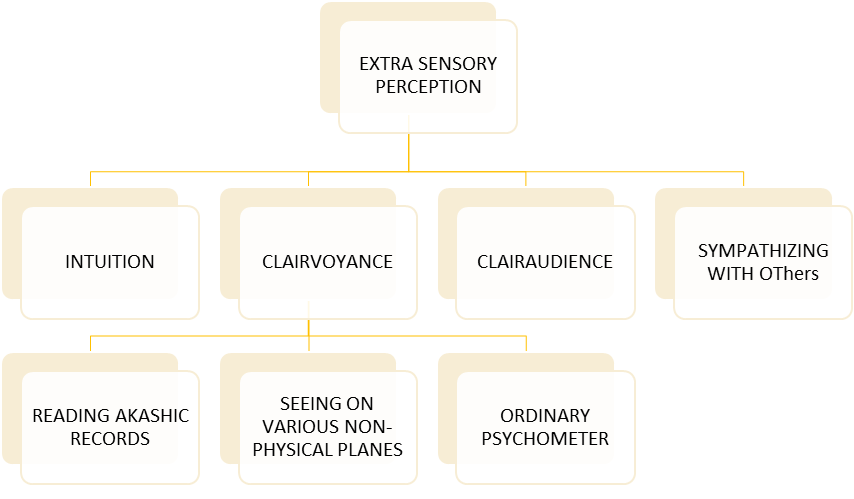
Extra Sensory Perceptions include a broader category as seen above. Since we’ve already discussed Intuition, let’s see what the other terms mean!
CLAIRVOYANCE
Clairvoyance is the ability to see things and receive visions from different planes of existence such as Etheric, Astral, Mental and Causal Plane.
The Centre between the eyebrows is termed as ‘Ajna’ in Sanskrit and the activation of this chakra in the Astral and Etheric body can result into Clairvoyant abilities at Astral Level. As the Ajna Chakra develops in corresponding bodies (like Mental and Causal Body) on different planes, the level of Clairvoyance also simultaneously develop.
READING AKASHIC RECORDS
You must have heard of few people who claim that they can reveal your past life. Some of these people possess the ability of reading Akashic Records.
Akashic Records are the memory seen on the astral plane, which is just a recurring reflection from other higher planes. Akashic Records are also called “The Divine Memory” since they include everything that has happened in the history of mankind.
Sometimes, a developed ability of Clairvoyance can allow you to perceive memories on the Astral Plane and sometimes these might just appear as mere glimpses. Since these memories are a recurring reflection on Astral Plane, they can be really hard to comprehend. On the other hand, perceiving Akashic Records on Mental Plane is much more accurate and complete in nature, to do so, it demands faculties pertaining to Mental Plane.
ORDINARY PSYCHOMETER
An Ordinary Psychometer needs an object connected to the past scene he/she wishes to see. A crystal or any other object can also help them focus and access the past scene that they aim to perceive.
CLAIRAUDIENCE
To understand clairaudience better, you can read our blog on clairaudience.
Throat Chakra is called ‘Visuddha’ in Sanskrit. Awakening of this centre in Astral and Etheric body results in Clairaudience abilities. Clairaudience is the ability to hear voices, pleasant or unpleasant, from Astral Plane.
SYMPATHIZING WITH OTHERS
To sympathize with others is to feel what the other person or an entity is going through.
Anāhata, also called the heart chakra enables a man to sympathize with other astral entities and allows them to comprehend their feelings. Sometimes, the pain from the sufferer is also felt by the one who sympathizes.
One good way to start developing your intuitive abilities is through meditation. I personally prefer Grand Master Choa Kok Sui’s Twin Heart Meditation, which was awarded the first place at the Academy of Integrated Health & Medicine (AIHM) Annual Conference.
