The Trembling Reflection: How Emotions Affect Focus and Clarity
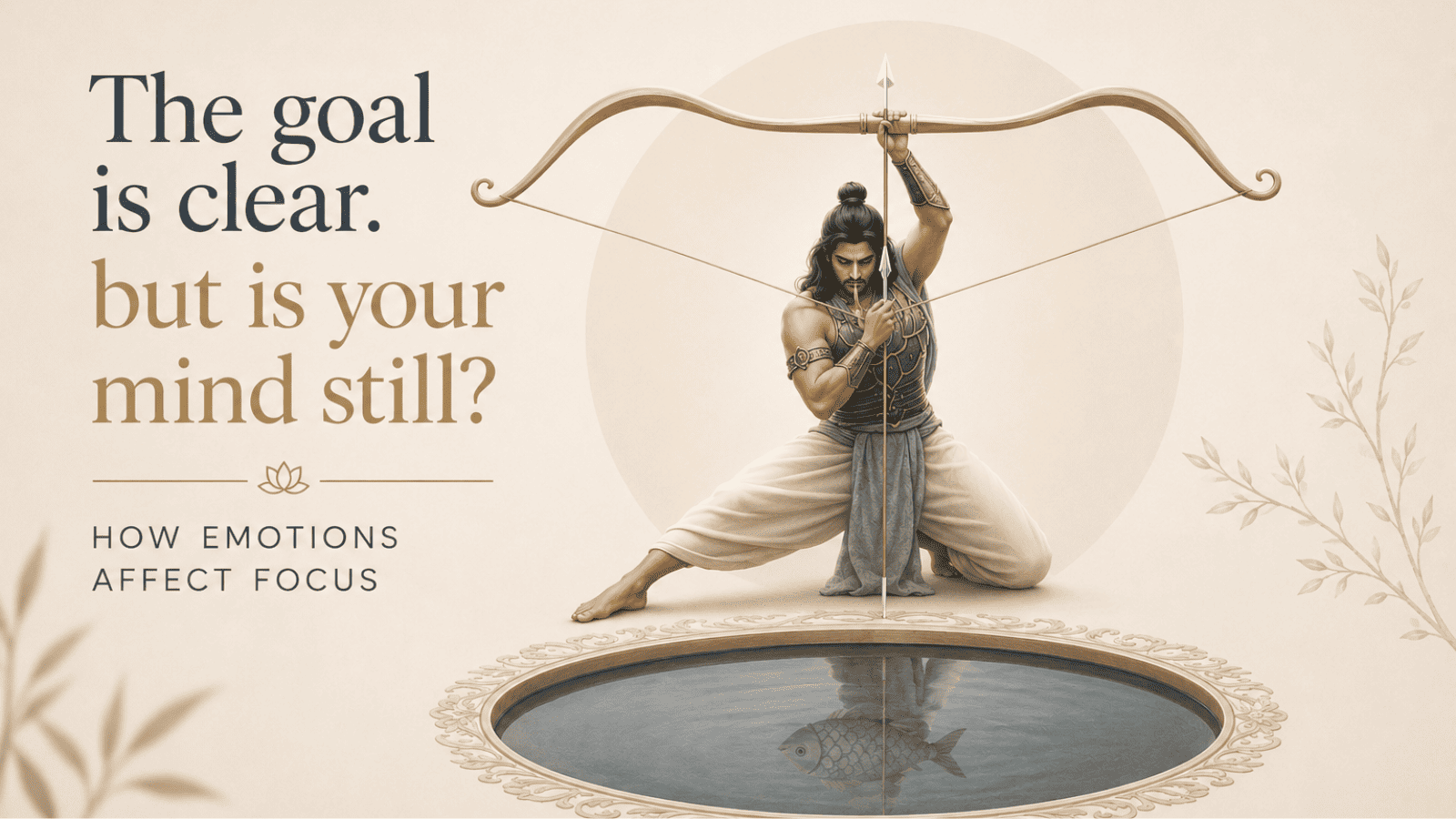
Why do people lose focus even when they know exactly what they want? Why do capable individuals abandon goals midway, become inconsistent, or allow temporary emotions to overpower long-term purpose? Often, the problem is not lack of talent or clarity, but emotional turbulence. Fear, anxiety, overthinking, disappointment, and emotional reactions constantly disturb the mind, making it difficult to sustain direction and effort. This is precisely how emotions affect focus. Interestingly, one of the most powerful symbolic illustrations of this truth can be found in the swayamvar of Draupadi in the Mahabharata – where Arjuna had to strike a moving target by looking at its reflection in water below.
Focus Is Not Just Mental – It Is Emotional
Most people think focus is simply a matter of concentration.
But in reality, focus is deeply connected to emotional stability.
A disturbed emotional state weakens clarity, consistency, and direction. Even when the goal is clear, distractions and emotional reactions can repeatedly pull the mind away from it.
The result is scattered effort.
This is why many people struggle with constancy. They may begin with enthusiasm, but emotional fluctuations slowly weaken sustained focus.
The issue is not always lack of intelligence or capability.
Very often, the issue is unmanaged emotional turbulence.
How Emotions Affect Focus
Emotions influence perception more than we realise.
When the mind is disturbed:
- small problems appear bigger,
- distractions become stronger,
- impulsive decisions increase,
- and long-term goals lose emotional intensity.
Fear magnifies obstacles.
Anger clouds judgment.
Overthinking drains mental energy.
Emotional hurt reduces consistency.
A person may still desire the goal, but internally their attention keeps shifting.
This is how emotions affect focus.
The goal remains the same, but the inner condition through which the goal is being perceived keeps changing.
And when the inner state is unstable, sustained direction becomes difficult.
The Hidden Symbolism in Arjuna’s Challenge
This truth is beautifully illustrated in the swayamvar of Draupadi.
A rotating fish was suspended high above the hall. The challenge was not merely to strike the target, but to do so without looking at it directly. The participant had to look into water below, observe the reflection, and then hit the eye of the fish accurately.
Many skilled warriors failed.
Then Arjuna stepped forward.
Calm and steady, he focused on the reflection and released the arrow successfully.
The symbolism here is profound.
The fish can represent a goal, purpose, or aspiration. But the most important element of the challenge was the water.
The target could only be seen through a moving and unstable medium.
That is exactly how human beings experience life.
We pursue our goals through the constantly changing medium of emotions, reactions, anxieties, desires, fears, and distractions. The “water” through which we see our purpose rarely remains still.
The challenge, therefore, is not merely achieving the target.
The challenge is maintaining clarity despite emotional movement.
Why Inner Steadiness Matters
This connects deeply with a teaching from Compassionate Objectivity: The Golden Lotus Sutras on Meditation: “Constancy of aim and effort is the quality needed for greatness.”
Greatness requires continuity of direction.
But continuity becomes difficult when emotions repeatedly interrupt focus.
A person who learns emotional steadiness develops greater clarity, better judgment, and stronger consistency. They are less easily distracted by temporary reactions and more capable of remaining aligned to long-term goals.
Arjuna’s success was not merely a display of technical skill.
It was also a reflection of steadiness under distortion.
Perhaps that is the deeper lesson hidden within the story:
the ability to remain inwardly stable while pursuing an important goal.
Because in life, distractions may never fully disappear.
The water may continue to ripple.
But the one who learns to maintain focus despite the trembling reflection eventually strikes the target.
If you would like to explore this subject further, you may also enjoy reading:
How to Stop Overthinking and Reacting: Regain Clarity with Meditation